
A solar system is installed on the roof for the long term. If the roofing or the waterproofing is already old, the areas under the panels become harder to reach later. A later repair then generally involves more work and can cost more than if the condition of the roof is sorted out before installation.
In short
- A solar system stays on the roof for the long term, and the roofing underneath is hard to repair later.
- Before installation, have the waterproofing and the penetrations checked, on a flat roof the drainage, on a fibre-cement roof the condition of the sheets.
- If the waterproofing is old, renovate the roof first. Load-bearing capacity is assessed by a structural engineer.
Why does the condition of the roof matter?
If the roof leaks, the water can stay hidden under the panels for a long time before its traces show. After installation the panels cover most of the roofing, so fewer signs are visible as well. The area under the panels is generally the hardest point of the roof to inspect, so it is worth clarifying its condition before installation. A later repair generally requires the panels to be dismantled as well. The roof and the solar system generally age at different rates, so it is worth surveying the roof separately.
What should you have checked?
A professional should check these on site. From the ground, you should only watch for visible signs, such as stains on the wall, fallen debris or standing water around the drain, and report them.
- Condition of the waterproofing. The condition of cracks, flashings and junctions, especially with old waterproofing.
- Penetrations. The chimney, vents, antenna mount and earlier cable ducts can be weak points. The cables and mounting of the solar system can mean new penetrations, so it is worth agreeing this with the installer in advance.
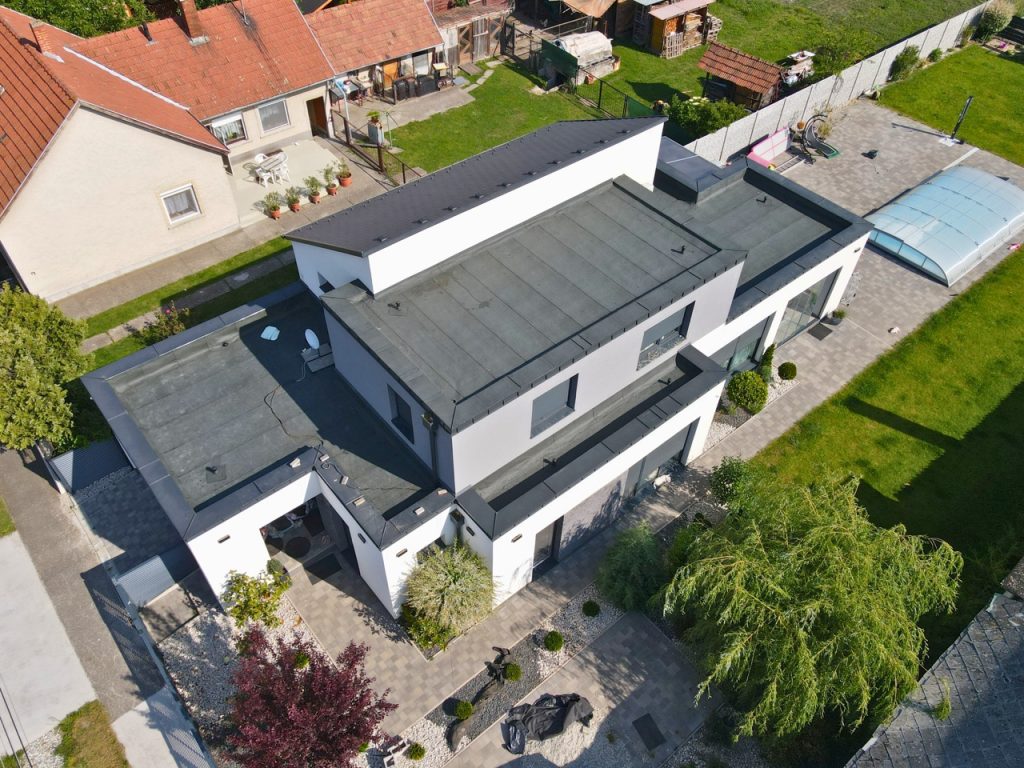
- On a flat roof, the layer build-up and drainage. It is important to know how many layers the waterproofing has, and whether there is a slope and a working drain. Standing water can cause problems under the panels as well. If the layer build-up is not known, it can be clarified at the on-site inspection.
- On a fibre-cement roof, the condition of the fibre-cement slate. Broken, slipped or cracked fibre-cement slate or sheets, or loose fixing. With old fibre-cement slate, it is also worth having the question of asbestos clarified by a specialist.
If you have them, prepare the roof’s documents: the year the building was built, the age of the roofing, earlier waterproofing or repair invoices and warranty documents, and a description of earlier repairs. These help the work on site, but the actual condition has to be checked on site.
Structural engineering: a separate professional question
Whether the roof can bear the weight of the solar panels and wind or snow loads can only be judged by a structural engineer. Tető Mesterfokon does not issue structural certificates. We can survey the condition of the roofing and the waterproofing and, if needed, repair them. If the structural engineer considers it necessary, examining the structure can be part of the solar design. Our task is the condition of the roofing and the waterproofing, not judging the load-bearing capacity.
What to do if the waterproofing is old?
If the waterproofing is old, it is worth renovating the roof before the solar system, so that the areas under the panels do not have to be touched later. Roofs covered with fibre-cement flat slate, corrugated fibre-cement sheets or asphalt shingles can often be renovated without removing the old covering. Whether this is possible on your roof becomes clear after the on-site inspection. The same solution does not suit every roof. If the roof renovation and the solar installation take place in the same year, it is worth agreeing the order with the contractors in advance.
Renovation by roof type: flat roof waterproofing, fibre-cement roof renovation, shingle roof renovation.
What should you ask the installer?
If another company installs the solar system, ask in advance how the fixing and the lead-through are done, who is responsible for the sealing, and what warranty applies to the roof penetration. It is worth setting these out in writing in the contract.
What should you do now?
Request a free on-site inspection before you choose the installer of the solar system. After the inspection we send an itemised, written quote for the recommended work. Phone: +36 20 553 2800. E-mail: info@tetomesterfokon.com. How to request a quote: How to request a quote.
Problem with your roof?
After a free on-site survey we give you an itemised quote.